
Services
Diagnostics, experimental trials, training and field advisory services
Nematode diagnostics
- Complete nematological screening (motile stages and cysts)
- Targeted counting of plant-parasitic nematodes belonging to specific categories: root-knot nematodes (Meloidogyne spp.), cyst nematodes (Heterodera spp., Globodera spp.) and migratory nematodes (Pratylenchus spp., Longidorus spp., Ditylenchus spp. and others)
- Detection of Xiphinema index, vector of grapevine fanleaf virus, for the assessment of soils intended for vineyard replanting
- Morphological identification to genus and species level
- Assessment of nematological risk at the pre-planting stage
- Determination of the gall index on root systems
- Nematofauna composition and parasite/predator ratio
- Analyses on soil, growing media, roots, seeds, plant tissues and water
Extractions are carried out according to recognised official methods, described in EPPO Bulletin 43.
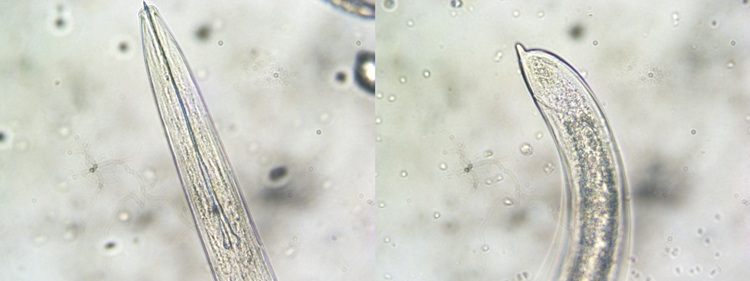
Nematofauna analysis
The report is not limited to counting the parasites. It sets out the composition of the entire soil nematode community, broken down by trophic role — parasites, predators, omnivores and decomposers — together with the calculation of the parasite/predator ratio.
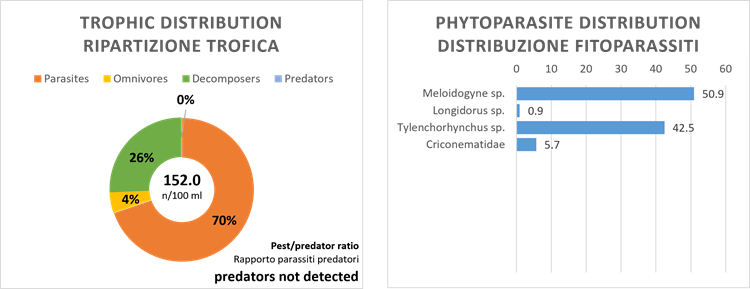
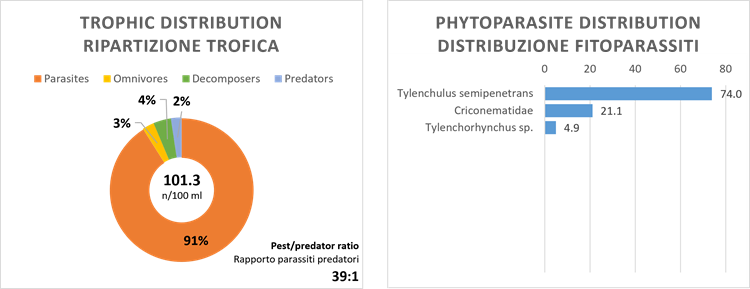
This picture provides an indicator of the biological status of the soil that counting plant parasites alone cannot give. It is useful in planning replanting, in assessing the effect of treatments on the beneficial soil community, and in monitoring integrated or organic management systems.
Nematicide efficacy trials
In vitro experimental work is carried out at the Horto Service laboratory. Trials in growth chambers and under glasshouse or field conditions are carried out in close cooperation with the AgroService Test Centre in Andria (Apulia, Italy).
How a trial is designed
The design of the study is determined by the expected efficacy of the formulation under test. It governs the choice of reference product, the experimental design, the crop, the duration of the trial expressed as the number of generations of the parasite, and the timing of the intermediate nematological assessments.
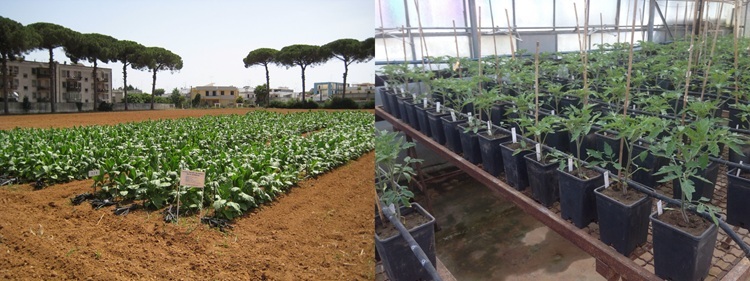
A highly effective formulation requires stressful conditions, high parasite pressure, a fumigant reference product and assessment over two to four generations, on long-cycle crops. A formulation of modest efficacy is assessed over one to two generations, with a liquid contact reference product and limited pressure, on short-cycle crops.
The importance of an intermediate assessment
The high biotic potential of root-knot nematodes leads to rapid population build-up. Within two to three generations the waves of infection saturate the feeding sites and the infestation tends to level off at the highest values observable in the field, irrespective of the initial differences between treatments.
As a result, the initial efficacy of control is progressively masked. An assessment carried out too long after transplanting therefore risks failing to discriminate between genuinely different treatments: for this reason an intermediate assessment, particularly on roots, may prove more informative than the final one, and makes it possible to establish for how long the crop actually remained protected.
Selection and management of trial sites
- Consistency of the site's characteristics with the aims of the experiment: expected efficacy, history of damage, planned duration
- Exclusion of areas treated with nematicides in the preceding period, to avoid residual effects on the uniformity of the trial environment
- Uniformity of the area in terms of recent cropping history
- Preliminary assessment of presence, uniformity and level of infestation, with the option of supplementing with artificial inoculum in less affected areas
- Careful preparation of the surface, levelling, correct installation of the irrigation system, weed control
Application of the formulations
For chemigation trials a dedicated plot-level irrigation system is used, with the same layout and spacing as the farm system, laid out on prepared and levelled ground. Each plot has its own manifold, left in place for subsequent applications.
Pressure-compensating low-flow emitters are used, to promote horizontal wetting of the soil. The volumes of water allocated to each plot are pre-measured, and delivery is fractionated and slow, so as to avoid surface run-off and deep drainage. The water status of the soil is checked before application, with pre-wetting on the previous day where necessary.
In vitro and controlled-environment testing
The activity of a substance can be verified at scales progressively closer to real conditions, before committing resources to a field trial. Horto Service carries out the entire sequence.
Preliminary in vitro assays
Determination of the lethal doses LD50 and LD90 on infective juvenile stages. Egg masses are collected from infected roots and incubated in distilled water in a growth chamber at 25 °C. The emerged J2 juveniles are collected and divided into calibrated aliquots, to which the treatments are applied at the concentrations under test. Studies of this kind serve to determine the nematicidal and nematostatic potential of a substance, as well as the persistence of its efficacy after exposure has ended. Hatching tests are also carried out directly on the egg masses.
Preliminary pot assays with artificial inoculum
Trials on inert sand or steam-sterilised sandy soil, which place no limit on the number of treatments that can be compared. The inoculum is obtained by mass extraction of eggs from infected roots, divided into calibrated aliquots and applied in suspension at a known density.
Treatments are applied as a drench at limited flow rate, with pre-wetting and reproduction of the chemigation stages. Assessments cover biometric parameters, gall index and reproduction rate of the parasite at the end of the first and second generation.
Inoculum production
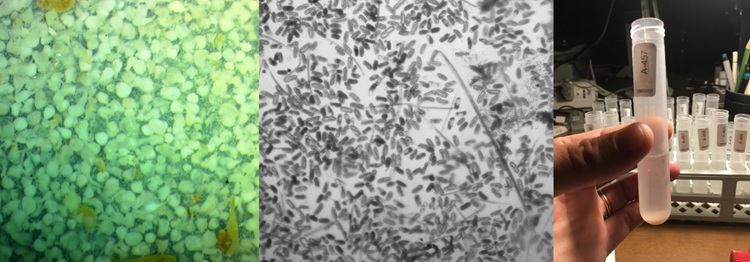
The laboratory produces inoculum of Meloidogyne spp. by mass extraction of eggs from infected roots. The availability of calibrated inoculum is the precondition for reproducible assays, and also makes it possible to even out the infestation at field trial sites where the natural distribution is uneven.
Training
Horto Service designs and delivers technical training courses in agricultural nematology for trial technicians.
The content covers the biology of plant-parasitic nematodes, population dynamics and interaction with the environment, sampling criteria for soil and plant matrices, the principles of integrated control, and the design of experimental trials in accordance with Good Experimental Practice.
Technical advisory services
- Agronomic advice for horticultural crops in open field, under protected conditions and in soilless growing
- Mineral nutrition and fertigation management
- Integrated pest management and handling of plant health problems
Horto Service also operates internationally, providing technical assistance, training of local technicians and field diagnostics.
For non-nematological analyses — microbiological, chemical or physical — the laboratory relies on external facilities.