
How to send a sample
Collection, packaging and shipping
Nematodes are not uniformly distributed in the soil: their distribution depends on soil type, temperature, moisture, host crop, overwintering or aestivation survival, and the presence of other pathogens or natural antagonists. Correct sampling is the precondition for a representative analytical result.
1. Defining the purpose
Before sampling, the objective of the analysis must be established, since it determines the matrix to be sampled, the sampling intensity and the timing of collection.
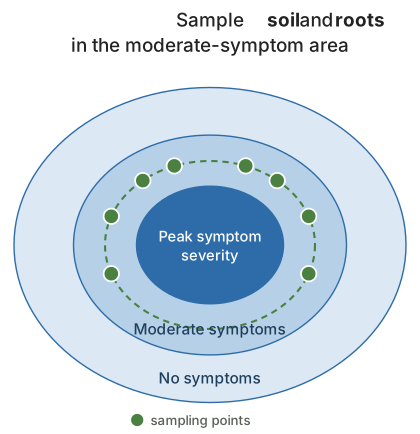
- Diagnosis of ongoing damage — the aim is to identify the cause of a decline that is already visible. Sampling targets the symptomatic plants and their root systems, in the transition zone between the affected and the healthy area: at the centre of the patch the roots may already be degraded and the nematodes may have left it.
- Detection of presence — the aim is to establish whether a given nematode is present or absent. This requires high sampling intensity, proportionate to the required level of detection, and particular attention to depth across the entire area represented.
- Estimation of population density — the aim is to quantify the infestation, in order to assess the risk to the planned crop or to compare experimental treatments. This requires a large number of subsamples distributed across the entire area represented.
2. Which matrix to sample
Four matrices can be sampled:
- Soil — for the estimation of population density and for risk assessment in the absence of a crop. Sampling soil alone once the crop is established strongly underestimates the actual population. When a crop is present, parasitic nematodes must be sought on the plant or within its root zone. At the end of the crop cycle, most eggs and juveniles are associated with the fine roots.
- Roots — essential for endoparasitic forms and for the identification of certain species
- Aerial plant parts — stems, leaves and bulbs, for foliar and stem nematodes. Some parasites, such as Ditylenchus dipsaci, must be sought on the plant when a crop is present: they would be difficult to recover from the soil.
- Water — for detection in irrigation systems and soilless growing: 1-2 litres collected at the bottom of tanks or from the sediment in filters, avoiding running water
3. Soil sampling scheme
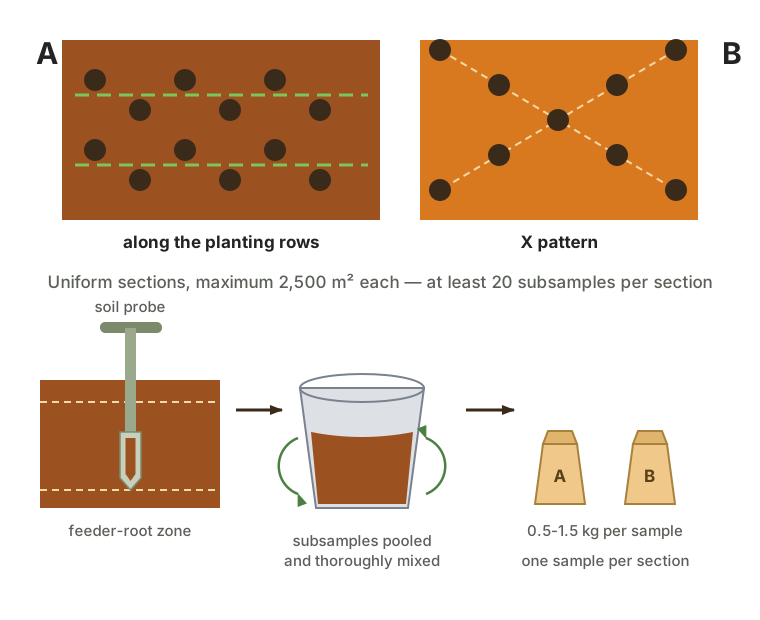
Divide the field into sections that are uniform in soil type and crop. Each section must not exceed 2,500 square metres and must be sampled independently.
The number of subsamples — the cores collected with a probe and pooled to form a single sample — varies with the purpose of the analysis:
- On-farm self-monitoring: 10 to 20 subsamples per section
- Experimental plots: not fewer than 20 subsamples per plot (EPPO PP 1/321 and PP 1/322)
Bare soil or soil with a growing crop
- Bare soil — fallow ground, land being prepared, or soil after crop removal: soil alone is collected. The analysis returns the population level present and allows the risk to the planned crop to be assessed.
- Soil with a growing crop — both soil and feeder roots are collected: fine roots bearing root hairs, not coarse material. The two materials provide complementary information, and the analysis is generally aimed at diagnosing a problem that has arisen in the field.
A rule of fundamental importance follows from this distinction. When a crop is present, sampling must be carried out in the root zone, close to the plants: plant-parasitic nematodes concentrate where they find roots to parasitise, and progressively migrate into the crop tissues. In the absence of a crop, with no root system as a reference, the sampling points must be distributed across the entire surface of the plot, so as to represent it as a whole.
Distribution of sampling points
Within each section the points must be distributed so as to represent the entire surface, avoiding concentration in a single portion. The commonly used schemes are the zigzag route, the X route and the W route, all intended to cross the area in different directions.
The choice depends on field conditions:
- Bare soil: routes covering the whole section. Points may where appropriate be concentrated along the planting rows of the previous crop
- Growing row crops: subsamples along the rows, following a zigzag between adjacent rows and avoiding the inter-row space
- Solid-seeded crops: W, X or zigzag route across the whole section
- Established perennial crops: subsamples along the drip line, one or two per plant
Sampling at crop removal
It is advisable to carry out the analysis when a crop is being removed, since the root system is then accessible and roots can be collected together with the soil; this is when the data are most complete. Moreover, the result becomes available while the decision on the following crop is still open, and can therefore inform it.
4. Sampling depth
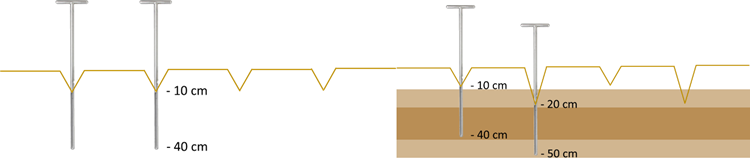
The general criterion is to sample the entire profile that will be explored by the roots. Nematodes are not found in the top 2.5-5 cm of soil, where environmental conditions are variable and extreme: that layer must be discarded, if necessary by removing it with a hand hoe.
Always sample within the feeder-root zone, whose depth varies with the crop: for most annual crops it lies largely between 15 and 20 cm, with a minimum of 5 and a maximum of 30-40 cm. For grapevine and tree crops it may reach 40-50 cm or more.
The presence of a root system is decisive in the distribution of inoculum along the vertical profile. For virus-vector nematodes — Longidorus spp., Xiphinema spp., Trichodorus spp. — occurrence has been described at depths well below the cultivated layer.
5. Sampling technique
Avoid sampling when the soil is very dry or very wet.
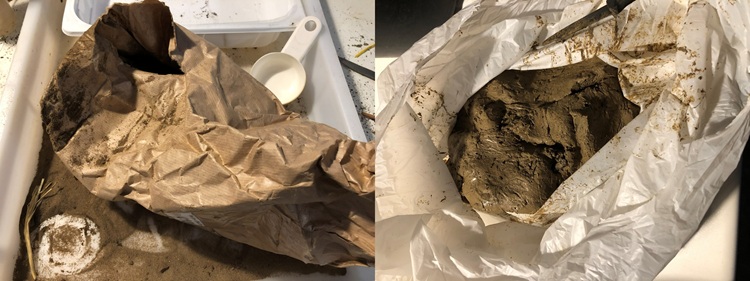
Collect vertical cores with a probe, which is preferable to a spade because it allows the whole profile to be sampled with a limited volume of soil: with narrow probes, between 10 and 17 mm in diameter, there is no need to reduce the sample in the field, an operation that introduces a further source of error.
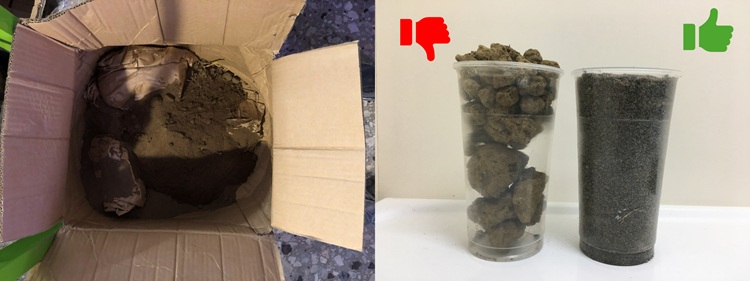
Discard the top 5-10 cm of soil. Pool the cores in a clean bucket or bag and mix thoroughly. Do not sieve to separate clods and gravel; remove them by hand instead. Then transfer into a non-biodegradable plastic bag a moderate quantity, sufficient for the analyses.
6. Quantity
The quantity depends on the type of extraction, which in turn depends on the target nematode:
- Root-knot nematodes (Meloidogyne spp.) and migratory nematodes (e.g. Pratylenchus spp.): 1,000-1,500 g of soil
- Cyst nematodes (Heterodera spp., Globodera spp.): 300-500 g of soil
- Xiphinema index: 1,000-1,500 g of soil
Root samples may be reduced to a few grams of feeder roots.
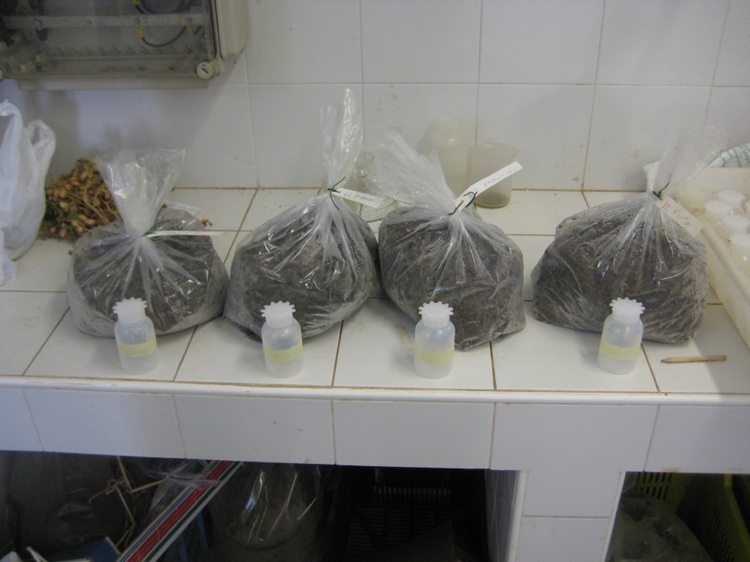
A sample much smaller than the sizes indicated may prove insufficient for any check analyses, especially where the gravel content is high. Samples exceeding the limits indicated substantially increase sterilisation and disposal costs, and may entail a surcharge on the cost of the analysis.
7. Root samples
What to collect: feeder roots, fine and bearing root hairs, not coarse or lignified portions. Collection should be carried out at random on several plants. Whole root systems may also be used. Roots must not be washed and should be packaged in a non-biodegradable plastic bag together with a small amount of the adhering soil, which protects them from desiccation.
For species identification collection should preferably be carried out at the end of the crop cycle, when adult specimens are certainly present.
For the gall index at least four whole root systems are required for each sample.
The most informative moment for a complete analysis is crop removal: the root system is accessible and it is straightforward to collect roots and soil in a representative manner.
8. Sample labelling
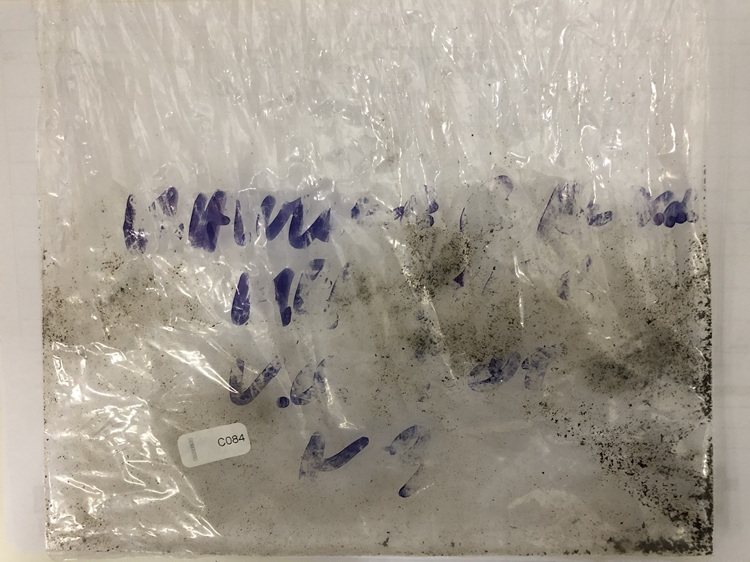
Write the identification on the outside of the bag with an indelible marker. Alternatively, a cardboard label written in pencil may be placed inside the bag: the ink of ordinary pens and markers becomes illegible within a short time in contact with soil.
Complete the identification by filling in the analysis request form, which must accompany the samples.
9. Storage
Keep samples away from direct sunlight, to avoid solarisation effects, and in a cool place until shipment. The sample must never be allowed to heat up or dry out. In summer use a cool box with ice. If shipment is delayed by a few days, store at 8-10 °C.
10. Shipping
Notify the shipment by e-mail to info@hortoservice.com, attaching the completed analysis request form, which can be downloaded from the Downloads page.
Send the samples, with a printed copy of the form, to:
Dr Giuseppe Lucarelli — mobile +39 338 8069190
Horto Service NemaLab
via San Pietro, 3/d
70016 Noicàttaro (BA) — Italy
Turnaround times
- Root-knot and free-living nematodes (e.g. Pratylenchus spp., Xiphinema index, and others): 7-10 days from receipt
- Cyst nematodes: 14-21 days from receipt (the sample may require air-drying for certain types of extraction).
Urgent requests must be notified in advance. Single extractions are then carried out, reducing turnaround by about 7 days and entailing a surcharge of 30% on the cost of the analysis.